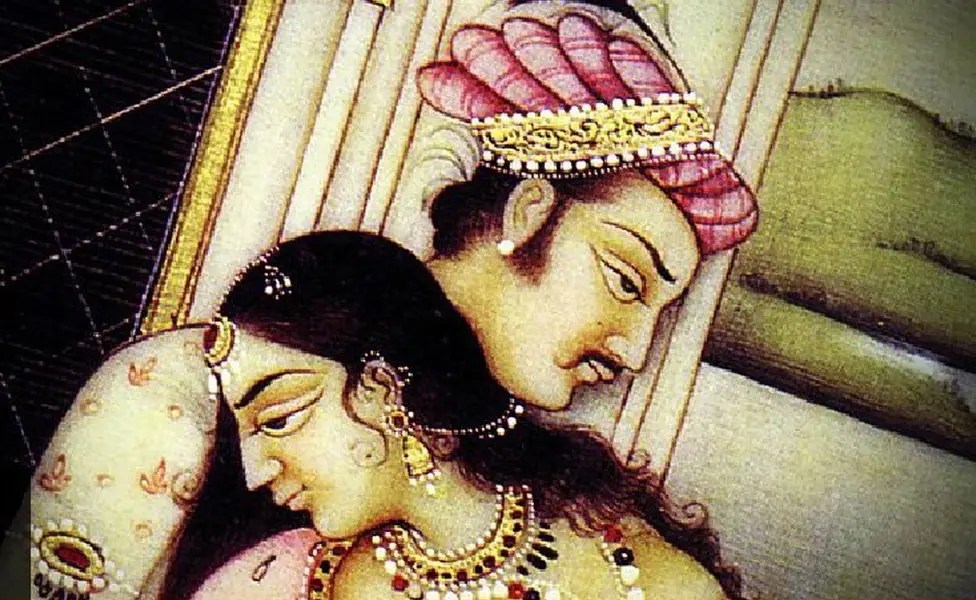
An ancient text published almost 2000 years ago, The Kama Sutra is perhaps the most famous erotic text of them all. The book has become a shorthand for an eastern sex manual, yet this is doing the book a disservice. It is as much an treatise of marriage and courtship as it is a sex manual.
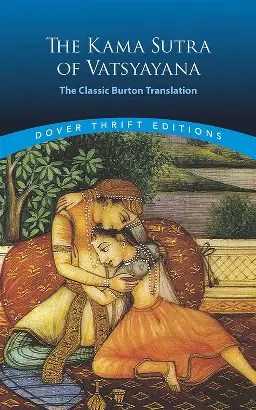
The book is attributed to Vatsyayna, and translated in English by the Victorian Richard Burton. Although not without its controversies, the English translation managed to guarantee that the book would be synonymous with Eastern eroticism.
Written in three parts, the first is concerned with proper study, becoming a good citizen. It tells us which women should be courted, when and where, and then gives us a list of women to be avoided. They include a leper, a lunatic, a woman who is extremely black, a woman who is extremely white, a woman is a female friend.
Part II is concerned with sexual union and divides men and women into three classes, according to the size of their ‘lingam’ and ‘yoni’. These are in Burton’s translation. Rather than referring to the genitals explicitly he has kept the original Sanskrit terms, which has suggested was a way to make the book more acceptable to the English public.

The book then goes on to detail the types of embrace that occur during the love union. Its this part that has been of most interest to readers. There are sixty-four positions listed in the text. Example: ‘When the woman places one of her legs on her lover’s shoulder, stretches the other out, and then places the latter on his shoulder, and stretches and continues to do so, it is called the ‘splitting of the bamboo.’
As well as a guide to different forms of intercourse, the book is a treatise of men and women, how to have a good marriage, and when adultery is acceptable. For a nearly 2000 year old text, these are very advanced subjects.
There are ten key lessons that we can take from the text:
Desire is Natural
But it should be refined. And pleasure isn’t shameful, it’s a natural part of life.
The art of attraction begins before touch
it’s in how we dress, move, smell.
Mutual consent and pleasure are essential
The Kama Sutra emphasises mutual enjoyment, a radical idea for its time. The aim is shared ecstasy, rather than domination. The book is very clear that men shouldn’t try to overpower women. Partners need to practise to learn each others rhythms and needs.
Knowledge deepens intimacy
Vatsyayana encourages lovers to study each other – emotionally, mentally, physically. The more we can know our partner’s desires and temperament, the deeper the connection becomes.
Timing matters as much as passion
The book teaches patience as much and anticipation. Love should unfold at the right pace. Anticipation is its own reward.
Confidence is Beauty
Elegance and self esteem are more seductive than looks alone.
Emotion fuels Passion
Tenderness and trust make every touch more powerful.
Love has many moods
Flirtation, jealousy, reunion – each a part of the dance. And those that enjoy the dance most are the last to leave the party.
Women’s Pleasure Matters
The Kama Sutra is notable for its focus on female pleasure, and instructs men in learning how to understand their desires.
Life itself is sensual
Eat, move, love – with awareness and style.
Because it’s not just about what happens in bed…… it’s about how you live every movement.
The Kama Sutra has been published in several editions. Sometimes, the text has been updated. Some printings focus on the 64 positions. Here is a good book to start with:
https://www.amazon.co.uk/Original-Kama-Sutra-Completely-Illustrated
 Watch this and Chill
Leave a comment